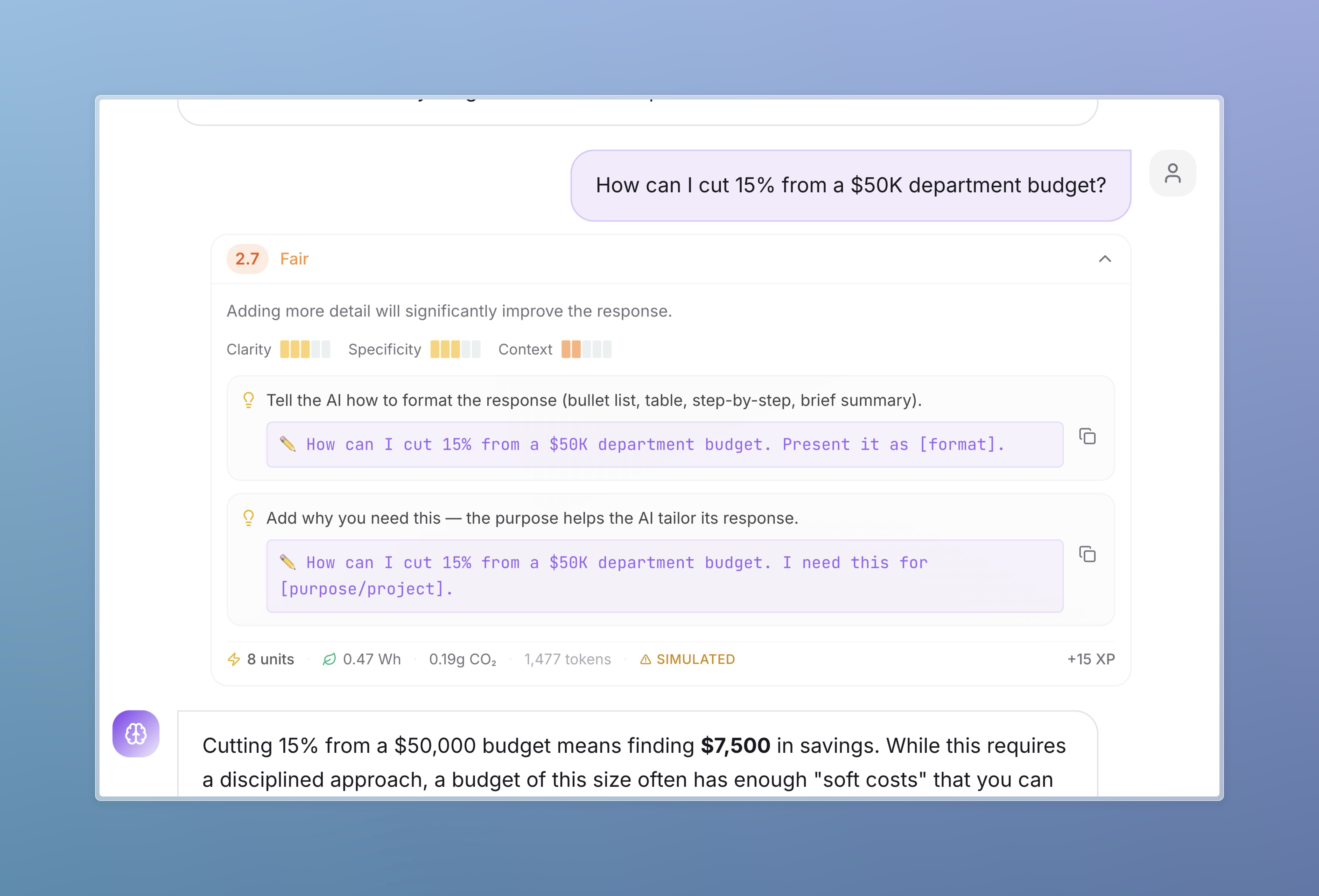
Gamifying Responsible AI Interaction
Most AI interfaces are built for speed. This thesis asked what happens when you design for reflection instead. ConpAI layered XP, ethical scores, prompt feedback, and energy cues onto a chatbot to make responsible AI interaction a little more visible, a little more structured, and a lot more human.
Abstract
Most AI chatbots are designed to get you to an answer as fast as possible. This thesis asked a different question. What happens when the interface is designed to make you a more aware, more informed, and more responsible user along the way?
The answer took shape as ConpAI, a functional gamified chatbot prototype that layers XP, an ethical score, prompt feedback, and energy cues over a familiar chat interface. ConpAI was evaluated against participants' own preferred chatbots with 57 people, 22 in guided sessions and 35 through a flow they ran on their own, using SUS, AttrakDiff, and custom engagement and responsible AI scales.
The short version of what came back: usability and reflection improved together. ConpAI scored higher on usability, task support, and engagement, and the gameful layer read as meaningful rather than distracting or childish.
Introduction
AI tools are everywhere now. Most people use them daily, for writing, research, planning, coding, making decisions. The adoption has been fast and the interfaces have gotten very good at one thing: getting you to the answer quickly.
But that speed comes with a tradeoff that mostly goes unnoticed. When a chatbot gives you a confident answer, how do you know if it's accurate? When you share context to get a better response, do you think about what you're actually disclosing? When the output feels slightly off, do you question it or just use it anyway?
Most chatbot interfaces don't help you think about any of this. There are no cues for hallucination risk, no feedback on whether your prompt was well framed, no signal that the AI might be reflecting a bias, and no visibility into the environmental cost of the interaction. These interfaces are designed to be efficient with minimal friction, and efficiency is not the problem. The question is what gets lost in that efficiency. How can an interface do more than just get you to the answer? How can it help you become a more aware, more informed, and more responsible user along the way?
This project started from that gap. Not to make AI harder to use, but to explore whether the interface itself could make responsible interaction feel more natural, more visible, and maybe even a little rewarding.
How can gamification strategies be implemented in an AI chatbot interface to shape user experience and support responsible AI interaction, and how do different users respond to these strategies?
Methodology
The project followed a Research Through Design methodology — the design work and the research happened together rather than one after the other, so building became a way of finding out, not just a way of delivering. The process moved through five stages.
Understanding the gap between how people currently use AI and what responsible AI interaction could look like — mapping existing literature on gamification, AI literacy, ethical design, and chatbot UX.
The Design: ConpAI
The outcome of the design process was ConpAI, a gamified AI chatbot interface built to make responsible interaction more visible without getting in the way of actually getting things done. It is organised into three layers, each addressing a different part of responsible AI use. Guidance shapes the prompt before it is sent, Reflection surfaces what usually stays hidden during the response, and Progress turns repeated use into a visible sense of growth.
The Interaction Loop
There is nothing to learn before the first message. The loop starts when a prompt is sent. The system analyses it while the response generates, and everything worth reflecting on arrives alongside the answer.
Inside ConpAI: Home
The home screen is where Guidance sets up the session and Progress shows what repeated use has built.
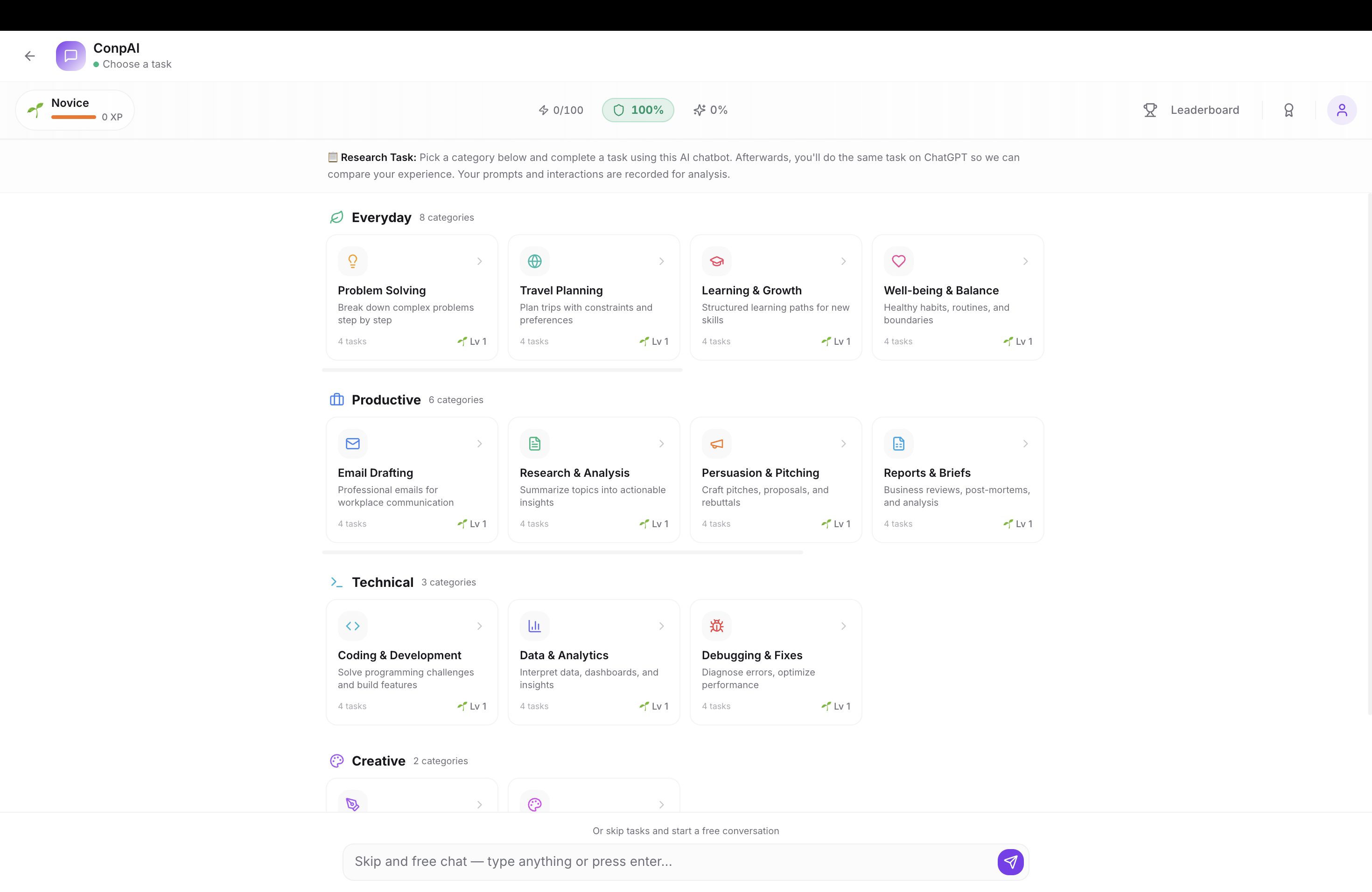
Preset task types give open ended interactions a starting point, so a blank chatbot has orientation.
Inside ConpAI: Chat
The chat interface is where Guidance and Reflection do their work, in the flow of a real conversation.
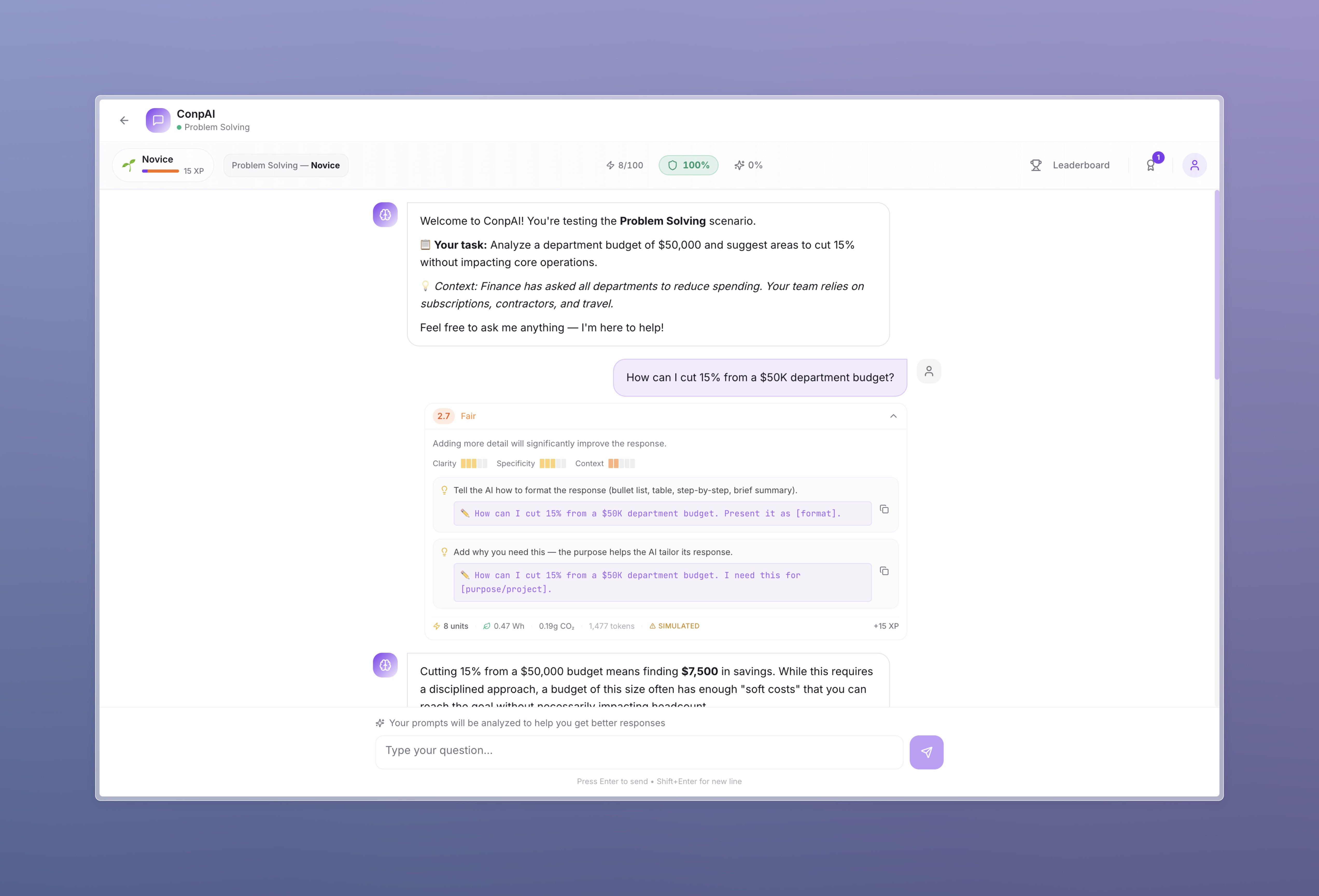
Each prompt is broken down across clarity, specificity, and context, with suggestions to improve it in real time.
Results
After testing with 57 participants, ConpAI scored higher than participants' preferred chatbots on usability, task support, engagement, and overall perception of gamified elements.
Discussion & Limitations
This project had real limitations worth being honest about. Sessions were short, which meant the findings reflect first impressions more than long term behaviour. The responsible AI metrics in ConpAI were simulated rather than pulled from a live model, so the feedback was directionally useful but not technically precise. And the participant sample skewed toward Explorers and Speed Users, which means the Careful and Minimal User findings are harder to generalise from.
That said, a few things surprised me. The finding that usability and reflection could improve together was not a given going in. There is a common assumption that adding guidance and feedback to an interface makes it heavier and harder to use. ConpAI suggested that when those layers are tied to the task rather than bolted on top of it, users don't experience them as friction at all.
If I were to take this further, the most interesting direction would be personalisation. A system that adapts its level of guidance to the user's persona in real time, stepping back for Speed Users and leaning in for Careful Users, feels like the natural next step.
Conclusion
Gamifying Responsible AI Interaction was submitted as a Master Thesis at KTH Royal Institute of Technology in June 2026, in collaboration with Conpend, Amsterdam.
The thesis explored a design direction rather than a finished product. ConpAI was a research artefact, built to ask a question and gather evidence around it. The answer, that gamification can support responsible AI interaction when it is meaningful, task relevant, and adaptable, feels like a starting point more than a conclusion.
There is a lot more to explore here.