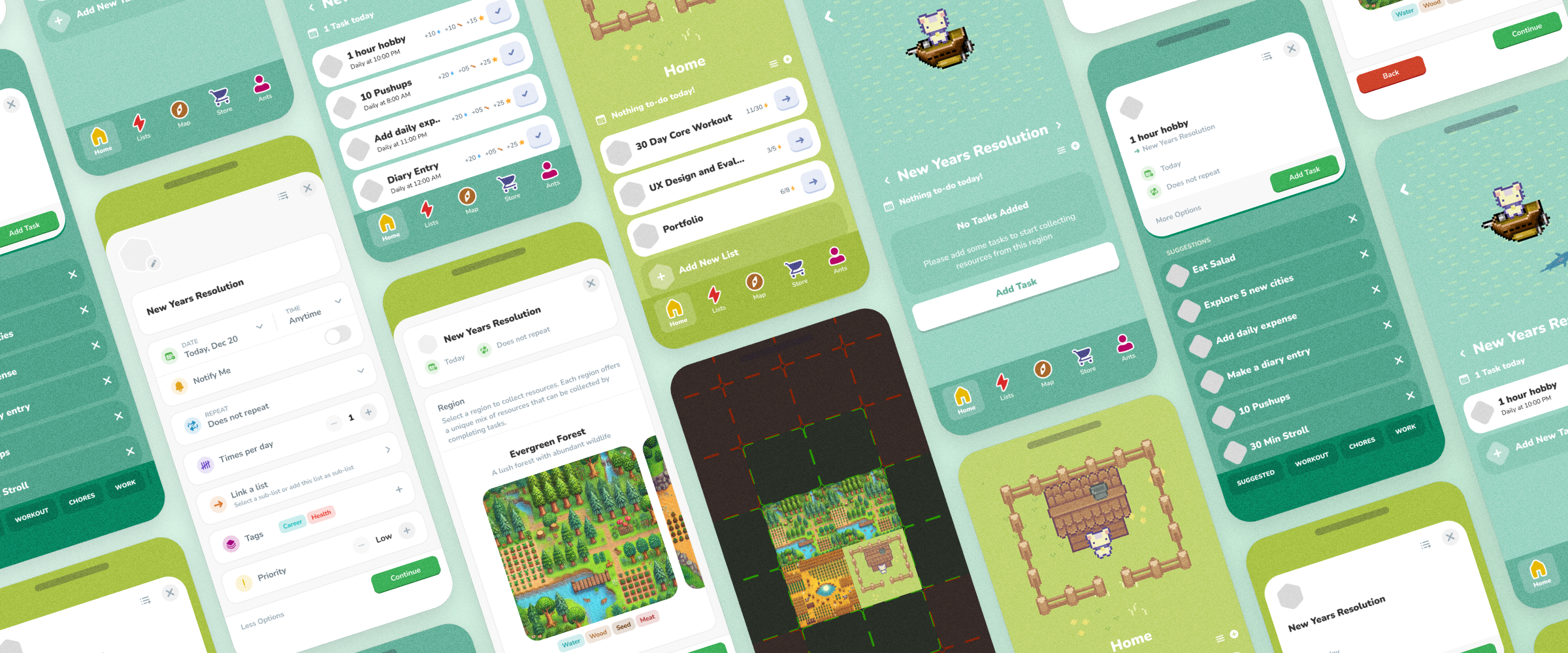
Star-Do Valley
A course design challenge with a simple prompt: take what games do to keep people coming back, and use it to make a to-do list better. My answer was to stop treating the game as a reward bolted onto the work. In Star-Do Valley, every list is a piece of land, every task spawns an enemy on it, and the only way to win is to finish the chore in real life. The list is not a gate in front of the game. The list is the game. This is a concept and hi-fi prototype, not a working product.
The Challenge
The brief came out of User Experience Design and Evaluation at KTH, a course built around game UX and grounded in a guest lecture by Lidia Chía Jiménez, a lead UX designer whose work spans titles like Fall Guys and Crash Bandicoot: On the Run. The prompt was deceptively small. Take what games do to keep people coming back, and use it to make a to-do list app better.
The honest starting point is that most to-do apps already work fine as tools. You can add a task, set a date, check a box. The thing they cannot do is make you want to come back tomorrow. A game gives you a reason. A task list mostly gives you guilt.
So the real challenge was never "build a better list." It was borrow what keeps people loading a game every day, and point it at the most unglamorous job in productivity: actually finishing things. The features were never the problem. The motivation was.
Approach
The work moved through Discover, Define, and Ideate. The first two phases were team work with Nauvyashree, Elin, and Ina. The game UX layer that follows is my individual continuation of that shared foundation.
Discover: why do we come back?
Rather than start at to-do lists, we started one level up and asked what pulls anyone back to a game or an app at all. Six drivers came out of it:
- Rewards that make you want to keep grinding
- Streaks that reward you just for showing up
- Social play, where the point is hanging out with friends
- Competitiveness, the ranked grind to be the best
- Difficulty that ramps gently and keeps you in the zone
- Story that makes the whole thing immersive
The decision that shaped everything: difficulty goes down, not up.
This is the call I am most sure about. Lidia's lecture frames engagement through Csikszentmihalyi's flow channel, the narrow band between boredom and anxiety where a player stays absorbed. Most games hold attention by ramping difficulty up to keep you climbing toward that band. A to-do list cannot afford that. Maintaining one is already work, and it already takes motivation just to open. Stack a demanding game on top and you are stacking effort on effort. So Star-Do Valley deliberately sits low on the difficulty axis. Calm, not demanding. The game's job is to stay in the sit-back zone while real life spends the player's energy.
That ruled out competitiveness and hard-difficulty mechanics early, and left rewards, social, and story as the levers worth pulling.
Define: the problem statement
How might we create a gamified to-do list app that leverages rewards, social features, and immersive storytelling to motivate users to complete their tasks, while fostering a sense of accomplishment and engagement?
Ideate: three worlds, one pick
Three directions went up on a FigJam board:
- Reward game. Finish your list, then unlock a small game as a treat. Productivity first, play as dessert.
- Task as level. Each task is a game level. Do the task in real life, then play its level to tick it off.
- Persistent world. A 2D pixel world that starts with a home base and grows as you add lists. Every task spawns an enemy. Completing tasks defeats enemies and gathers resources.
We went with the third. The first two keep the game and the work separate, you earn one by doing the other. The third fuses them. Your list is not a gate in front of a game, it is the game. The world only grows because you are getting your life done, and it visibly suffers when you are not. That tighter link is what made it worth building.
Difficulty, Inverted
Most games earn attention by demanding more of you. A to-do app cannot afford that, so Star-Do Valley turns the usual dials the other way.
One Task, Start to Finish
The layers above show the structure. This is the same loop the way a single task lives it, from the moment you write it down to the moment the world pays you for finishing it.
The Loop on Screen
The same journey in four screens, from an empty list to a piece of land with real stakes on it.
Reflection
The concept sits on a tension I kept circling back to. A to-do list is already an intrinsically motivated act. Nobody installs one because a shark told them to, they install it because part of them already wants their life in order. So the game layer isn't here to manufacture motivation. It's here to trigger the pull that's already there and give it something to push against.
The catch is that every modifier I added to do that, regions, resources, enemies, drops, is also a new thing to learn. And complexity is friction. The same systems meant to fire the motivation can just as easily smother it. The real design problem was never how much game can I add. It was how little game can I get away with while still making the work feel worth coming back to. I'm fairly sure the honest answer is less than what's in the concept.
There's also the gap between a concept and a real build. A concept always looks like a 100% solution, because nothing has broken yet. No edge cases, no confused first-time users, no one churning because the economy was a system too far. That polish is exactly what makes it untrustworthy. It's a design bet wearing the costume of a finished product.
Outcome
Star-Do Valley is a concept and hi-fi prototype, built as the game UX challenge inside KTH's User Experience Design and Evaluation course. There's no functional build and no user testing behind it yet, which is the most important thing to know before reading any decision here as more than a reasoned bet.
What it has is one clear idea: a to-do app where the only way to win is to do the thing. The list is the game, real-life completion is the only move, and the world grows because your life is getting done. The team carried it through Discover and Define. The game UX layer, the part that turns a list into living land, is mine.
What's changed since is that the distance between concept and tested build has collapsed. With where AI and vibe-coding tools are now, the version I'd have shelved as too ambitious for a course timeline is buildable by one person. So the next step isn't more features. It's putting the loop in front of the three target players to learn which parts of the world earn their place, and which were only ever fun to build, starting with the boldest question: does visible loss motivate, or just stress.