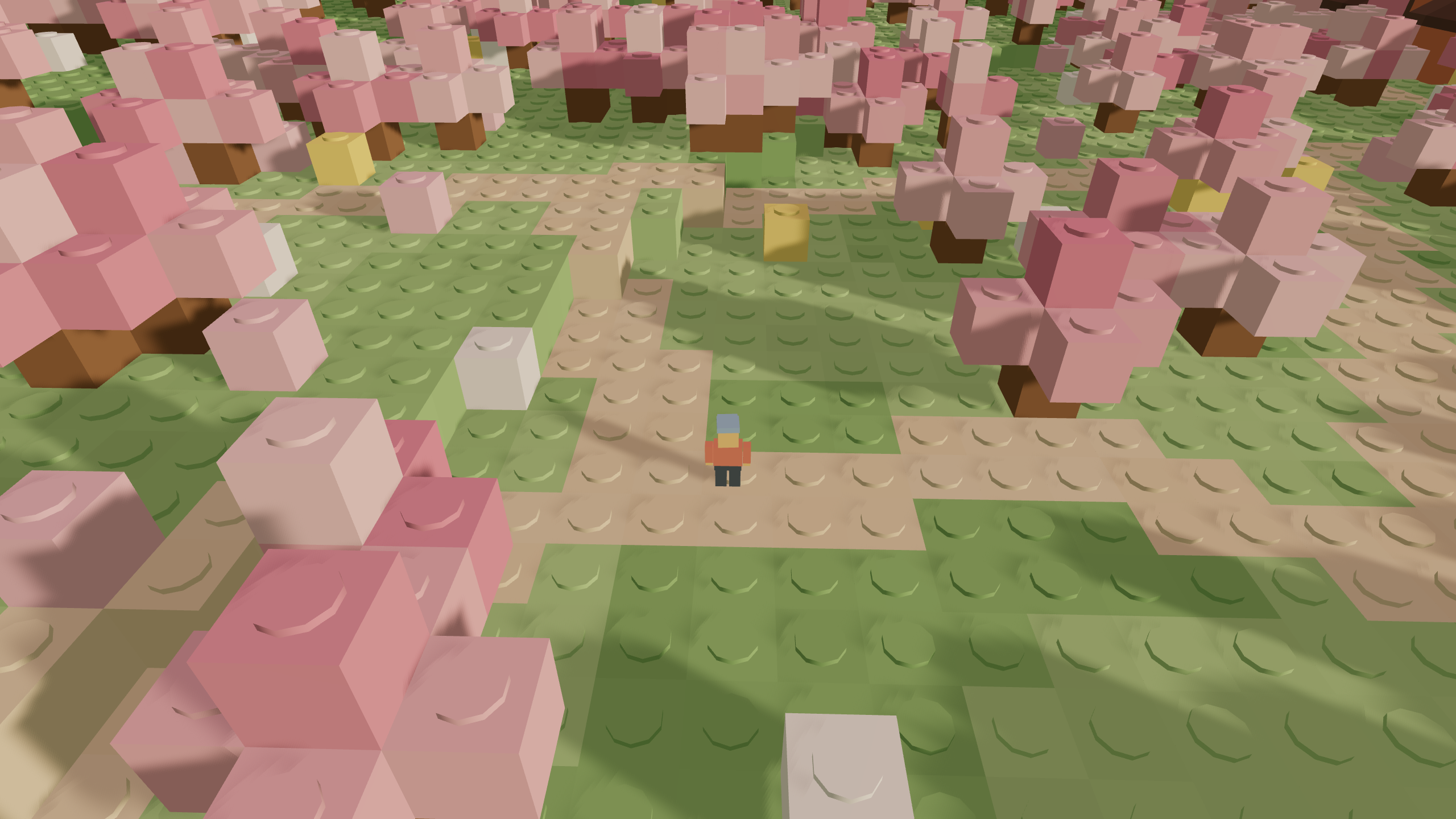
Brixel
Pick a real map square, your street, a landmark, a whole city, and Brixel brickifies it into a LEGO-style voxel world you can smash, rebuild, sandbox-build, or play hide-and-seek in with friends. A solo game design and game UX project built to test one bet: that recognising a real place does the work a tutorial usually has to.
The design hook
Most voxel and sandbox games start you on a blank or random world. Brixel's central bet is familiarity as onboarding: the first thing you see is a place you recognise, your neighbourhood, the Eiffel Tower, the Champ de Mars, rebuilt in bricks. Real-world geometry from OpenStreetMap footprints and elevation removes the blank-canvas intimidation and gives instant buy-in before a single mechanic is taught.
The design goal is to minimise time to delight. Recognition does the work a tutorial usually has to.
One pipeline, real maps
Player journey
Customise your minifig, then play solo or open a room with a four-letter code. The host picks the mode and map, shapes the world in the lobby, and everything autosaves so you can resume later.
- Low-commitment entry.You can play solo instantly, including a no-network Cozy Isle, or host or join a room with a four-letter code. No accounts, no installs.
- Host as director.One player shapes the shared world, brick size, tree density, palette, material, sky, weather, so the group is not stuck in menus together. Authority is centralised to keep multiplayer legible.
- Persistence and re-entry.Solo builds and Classic progress autosave, and a Continue entry resumes even after the room is gone. Losing progress is a top churn risk in sandbox games, so this closes that gap.
Level and world design
Brixel has two layers of level design working together.
- Generative levels, the map pipeline.Real OpenStreetMap data is voxelized into playable brick geometry, with elevation from terrain tiles so hills and riverbanks read correctly. This is procedural level design constrained by real space, so the job shifts from placing every block to tuning the rules, brick size, density, palette, water, tree scatter, that make a real place fun to move through.
- Authored set-pieces, landmark prefabs.Hand-built voxel prefabs, the Eiffel Tower, a Moulin-Rouge windmill, a gilded winged statue, are geotagged and dropped into arenas, painted in a distinct monument tint so they read as focal points. They give players orientation anchors and a sense of place inside an otherwise generated world.
- Arena tuning for Tag.The Tag mode uses purpose-shaped arenas, like a rebuilt Paris 3-Lane map at 120 to 180 metres, with terraced terrain and multiple lanes, sized for line of sight, chase pacing, and hiding spots rather than raw exploration.
Editing the generated world
Three loops, one world
Three gameplay modes share the same brick world, each with its own UX focus.
- Classic.Smash the model, collect bricks, follow the beacon, rebuild together. Guided, cooperative, forgiving. Beacons and a preview toggle keep goals legible, and bricks that sink in water can be dived for.
- Free Roam Build.Place, paint, remove, and eyedrop from a full brick kit, cubes and roof shapes, with a key to rotate. Creative flow through a tool-per-button toolbar, and you can edit the generated city itself, which blurs the line between level and sandbox.
- Tag, hide and seek.Seekers tag hiders while hiders blend, pose, cover, and ping. Round-based and role-assigned, tuned for tension and readability over raw exploration.
The Classic smash loop
A simple chase becomes a readable mind-game. Hiders camo-paint themselves, hold static poses to pass as scenery, wall themselves in to become safe, and use a directional ping that trades a small tell for information. It is the strongest emergent-fun surface in the game.
Cross-platform input and accessibility
Parity was a deliberate constraint: every action maps to keyboard, mouse, and touch. A virtual joystick and contextual action buttons appear on touch devices, and tap-to-move-to-ground works alongside WASD. Camera is orbit-drag and scroll-zoom everywhere.
Two open questions for the research phase: control discoverability, which keys do what per mode, and first-session legibility of the mode switch.
Feedback and game feel
- Audio.Fully synthesized in the browser with WebAudio, no asset files, for placement, smashing, and event cues.
- Wayfinding.Beacons guide the rebuild, and a preview toggle shows the finished target.
- Juice.Palettes, materials, sky, and weather are host-tunable, plus fireworks and celebration events on completion.
- Determinism.Brick physics is deterministic across clients so shared worlds stay consistent, a correctness choice that directly protects the feeling of a fair, shared space.
User research phase (planned)
The next milestone is a structured UX evaluation. This is framed as planned work, not results.
- Goals and hypotheses.For example, recognition of a real place reduces time to first action versus a random map.
- Methods.Moderated first-session playtests with think-aloud, a short SUS and UX questionnaire, and lightweight funnel instrumentation from customise to mode pick to first meaningful action to session length.
- Focus areas.Onboarding without a tutorial, mode discoverability, control legibility on touch versus desktop, and multiplayer join friction from room codes.
- Deliverables.A findings report, a severity-ranked issue list, and a prioritized redesign backlog.
What I claim as UX and design ownership
- The core bet and structure.Framed familiarity as onboarding and the three-mode structure.
- Generative plus authored levels.Designed the level approach across both layers, tuning generation rules and hand-building landmark set-pieces.
- The Tag hider toolkit.Designed poses, cover, camo, and ping as a readable stealth mind-game.
- Input parity and multiplayer model.Enforced full parity across desktop and touch, and a host-as-director multiplayer model with four-letter room codes.